
Design for recycling has become a central principle in packaging development. The direction is clear: simplify structures, improve sortability, and increase the quality of recycled outputs. In practice, that often means moving toward monomaterial packaging solutions.
But there is a complication that packaging teams know well: performance requirements do not disappear just because regulation changes.
For many applications, barrier properties remain critical. Shelf life, product protection, machinability, sealing behavior, and user experience all depend on packaging performance. This is where design-for-recycling ambitions can collide with technical reality.
Why barrier matters
Barrier performance is not a secondary feature. For many packaged products, it is the difference between acceptable shelf life and unacceptable product degradation.
Oxygen and moisture transmission rates are especially important in flexible packaging. Some categories can tolerate relatively modest barrier levels. Others, including products sensitive to oxidation or moisture, cannot.
Why polymers struggle compared with dense inorganic barriers
The technical reason is straightforward. Barrier performance follows diffusion physics.
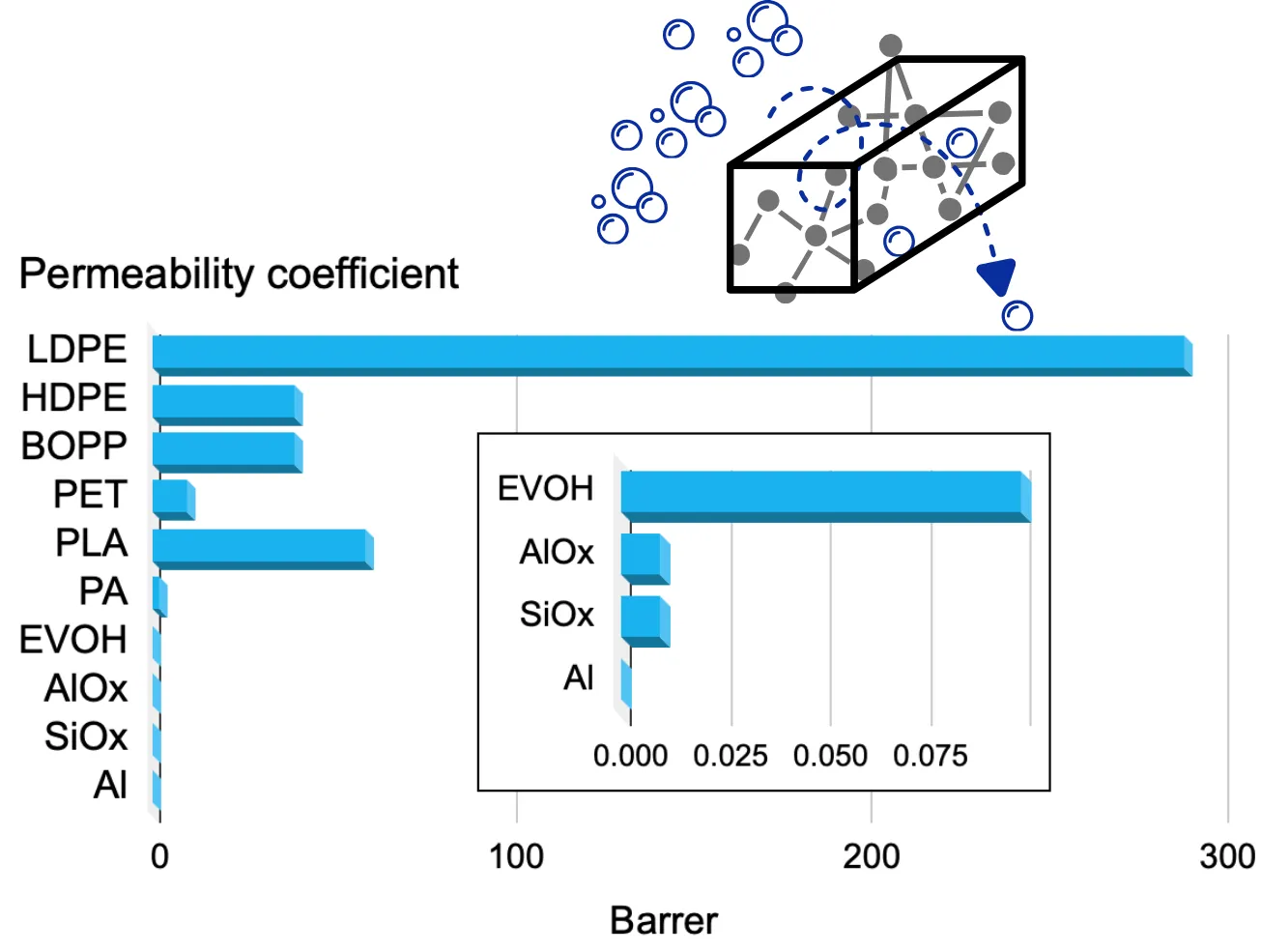
Polymers contain amorphous regions and free volume that allow small molecules such as oxygen and water vapor to dissolve and diffuse. Dense inorganic materials and metals behave very differently: their structure leaves far less free space for permeation, which is why they can suppress gas transfer by orders of magnitude. The chart and explanatory diagram in the uploaded PDF make this distinction especially clear on the oxygen barrier question.
This is why traditional high-performance packaging structures have often relied on multilayer combinations. They were not designed that way by accident. They were designed that way to meet product requirements.
The real trade-off: recyclability versus packaging performance
Mono-material flexible packaging can improve recyclability when properly sorted, but often comes with higher OTR/MVTR, narrower sealing windows, and a greater risk of slowdowns on packaging lines. By contrast, multilayer structures still offer very low barrier performance at thin gauge and stable runnability, even though their recyclability profile is weaker. Functional coatings and advanced mono-material combinations may help close the gap, but they introduce their own complexity and are not yet universally established in recycling systems.
In other words, the packaging industry is not facing a simple substitution problem. It is facing a system redesign problem.
Why switching materials can also affect brand value
Another important insight from the paper is that packaging performance is not only technical. It is also sensory and commercial.
Visual appearance, touch, stiffness, sound, sealing behavior, and shelf impression all influence consumer perception. Sustainable packaging changes can create unintended negative effects when they alter familiar consumer cues too aggressively. The well-known example of noisy compostable snack packaging and the market reaction to Snapple’s packaging shift as reminders that design-for-recycling cannot be separated from user experience and brand recognition.
This matters because a packaging redesign that improves recyclability but damages product perception may create a different kind of commercial risk.
What a pragmatic approach looks like
For some applications, mono-material packaging will be the right answer today. For others, the path may require staged redesign, advanced coatings, compatibilization approaches, or debonding and separation technologies that improve recovery without sacrificing performance.
Packaging teams need to balance recyclability objectives with shelf-life targets, line efficiency, and brand equity. The best solution is not always the simplest structure on paper. It is the structure that works in the real world while remaining compatible with the direction of regulation and recycling infrastructure.
The road ahead
The shift toward more recyclable packaging is real, and it is accelerating. The PPWR has made that direction even clearer by reinforcing recyclability and circularity as central design principles across the EU packaging landscape.
But there is still a critical need for technologies that bridge the gap between high packaging performance and strong recycling outcomes.
That is where innovation matters most: in helping brands and manufacturers redesign packaging systems that are technically credible, commercially viable, and future-ready.
Working through a barrier-versus-recyclability challenge in flexible packaging? Contact Ecolanka to discuss how to evaluate your SKU constraints and identify practical transition options.
Contact our team